Introduction
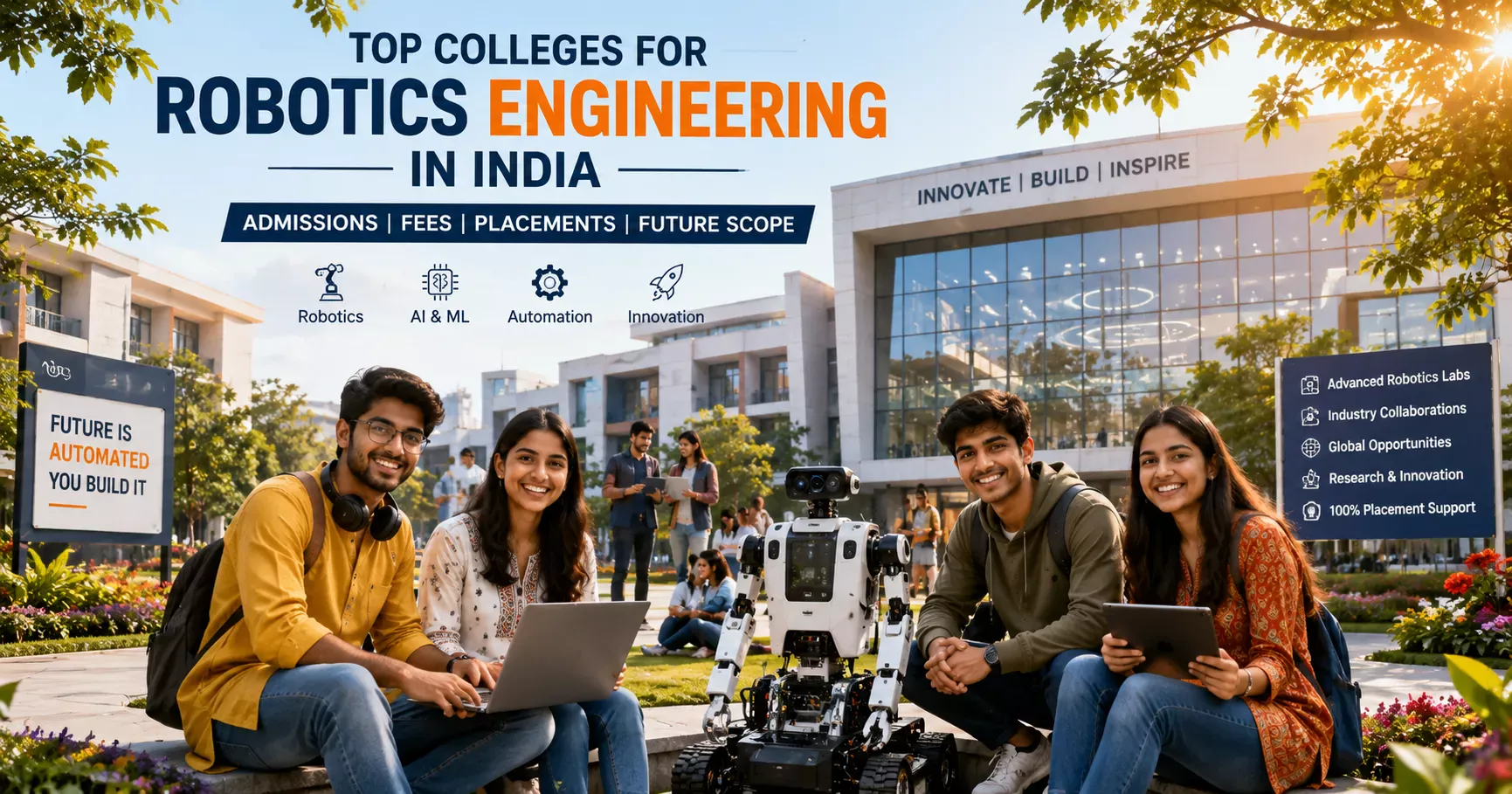
India is entering a new era of automation, artificial intelligence, smart manufacturing, autonomous systems, and intelligent machines. As industries become more technology-driven, Robotics Engineering has emerged as one of the most exciting and future-focused engineering disciplines for students who dream of building robots, automation systems, industrial machines, drones, medical robotics solutions, and intelligent manufacturing technologies.
The demand for skilled robotics engineers is growing rapidly across sectors such as automobile manufacturing, aerospace engineering, healthcare technology, defence research, warehouse automation, industrial robotics, artificial intelligence, machine learning, and smart factories. Consequently, students who choose Robotics Engineering today are preparing themselves for careers that will shape the future of technology.
Many parents feel anxious about selecting the right engineering college because robotics is still considered a relatively specialized field. Students often wonder whether robotics engineering has good placement opportunities, industry exposure, practical laboratory facilities, and long-term career growth. These concerns are completely natural.
From our years of guiding students at CollegeZollege, we have observed a significant increase in inquiries related to Robotics Engineering programs. Parents want transparency regarding fees, accreditation, placement records, faculty expertise, internship opportunities, and campus infrastructure. Students, meanwhile, seek colleges that provide hands-on robotics projects, innovation labs, startup incubation support, and industry collaboration.
India now hosts several excellent institutions that offer specialized robotics programs through B.Tech, B.E., M.Tech, integrated engineering programs, and interdisciplinary courses combining robotics, artificial intelligence, mechatronics, automation, electronics, and computer science.
As a trusted education platform, CollegeZollege.com consistently evaluates institutions based on academic quality, accreditation status, placement support, industry relevance, student satisfaction, infrastructure, and research opportunities. We always guide parents with transparent information so they can make confident educational decisions.
Before exploring the leading institutions, students may also benefit from understanding broader engineering and higher education opportunities through resources such as the comprehensive guide to Bangalore colleges available at https://collegezollege.com/bangalore-colleges-guide-/ which explains important admission trends and educational pathways.
Top Colleges for Robotics Engineering in India – Quick Overview
| College/University | Location | Course Type | Approx Fee Range | Accreditation |
|---|---|---|---|---|
| IIT Madras | Chennai | B.Tech & Research Programs | High | Institute of National Importance |
| IIT Kanpur | Kanpur | Robotics Research & Engineering | High | Institute of National Importance |
| IIT Delhi | New Delhi | Robotics & Automation Programs | High | Institute of National Importance |
| IIT Bombay | Mumbai | Robotics Specializations | High | Institute of National Importance |
| BITS Pilani | Pilani | Robotics & Intelligent Systems | High | NAAC Accredited |
| VIT University | Vellore | Robotics & Automation Engineering | Moderate-High | NAAC Accredited |
| SRM Institute of Science and Technology | Chennai | Robotics & Automation | Moderate-High | NAAC Accredited |
| Manipal Institute of Technology | Manipal | Robotics & Mechatronics | Moderate-High | NAAC Accredited |
| Amrita Vishwa Vidyapeetham | Coimbatore | Robotics Programs | Moderate | NAAC Accredited |
| UPES | Dehradun | Robotics & Automation Engineering | Moderate-High | NAAC Accredited |
According to national ranking frameworks and technical education authorities, institutions with strong research infrastructure, advanced laboratories, industry partnerships, and innovation ecosystems typically offer better robotics education outcomes. Students can verify rankings through NIRF India and accreditation details through NAAC.
Why choose this college/university?
Choosing the right robotics engineering college is about much more than securing admission. The institution should provide a complete ecosystem where students can transform classroom knowledge into practical engineering expertise.
Robotics is inherently multidisciplinary. Therefore, students require exposure to:
- Mechanical Engineering
- Electronics Engineering
- Embedded Systems
- Artificial Intelligence
- Machine Learning
- Automation Technology
- Computer Programming
- Sensor Technology
- Control Systems
- Industrial Design
The best colleges create environments where all these disciplines intersect naturally.
Strong Industry Demand
Automation is transforming industries worldwide. Manufacturing plants increasingly deploy robotic systems to improve efficiency, safety, and productivity. Healthcare organizations use robotic assistance technologies during surgeries and rehabilitation. Logistics companies depend on warehouse robots and autonomous systems.
Because of these developments, skilled robotics engineers are increasingly sought after by employers.
Research Opportunities
Premier institutions encourage undergraduate students to participate in research projects from the early stages of their academic journey.
Students may work on:
- Autonomous vehicles
- Drone technology
- Humanoid robots
- Medical robotics
- Agricultural automation
- Industrial robotic arms
- AI-powered automation systems
These experiences significantly enhance employability.
Innovation and Startup Culture
Many leading institutions actively support student entrepreneurship. Innovation centers, incubation facilities, funding opportunities, and mentorship programs help students transform engineering ideas into successful startups.
Several successful robotics startups in India were founded by graduates from engineering institutions that encouraged experimentation and innovation.
Global Career Opportunities
Robotics engineering skills are highly transferable internationally. Graduates often pursue opportunities in:
- Germany
- United States
- Canada
- Singapore
- Japan
- South Korea
- Australia
- United Kingdom
As automation expands globally, demand for robotics professionals continues to increase.
Advanced Laboratories
Modern robotics education depends heavily on laboratory experience.
Top institutions typically provide:
- Robotics simulation labs
- Embedded systems laboratories
- AI research centers
- Automation laboratories
- Industrial robotics training facilities
- IoT innovation centers
- Drone development laboratories
- Computer vision research labs
These facilities enable practical learning beyond textbooks.
Interdisciplinary Learning Environment
Students benefit significantly when colleges encourage collaboration across engineering departments.
For example:
- Computer science students contribute AI algorithms.
- Electronics students design sensors.
- Mechanical students develop robotic structures.
- Robotics students integrate complete systems.
This collaborative learning mirrors real-world engineering environments.
Students exploring broader engineering opportunities can also compare options through the detailed guide on top colleges in Bangalore available at https://collegezollege.com/top-colleges-in-bangalore/, which helps families understand differences among institutions and academic pathways.
Courses offered
Robotics Engineering programs vary considerably among institutions. Some universities offer dedicated robotics degrees, while others provide robotics specializations within broader engineering programs.
Undergraduate Programs
B.Tech Robotics Engineering
This is one of the most specialized undergraduate pathways available.
Core subjects often include:
- Engineering Mathematics
- Robotics Fundamentals
- Sensors and Actuators
- Artificial Intelligence
- Machine Learning
- Embedded Systems
- Mechatronics
- Industrial Automation
- Computer Vision
- Control Systems
- Robot Programming
Duration:
4 Years
B.E. Robotics and Automation
Some institutions offer Bachelor of Engineering programs focused on robotics and automation technologies.
Key learning areas include:
- Automation Systems
- Robotics Design
- Electronics Integration
- Industrial Applications
- Manufacturing Automation
Duration:
4 Years
B.Tech Artificial Intelligence and Robotics
An increasingly popular interdisciplinary course.
Students learn:
- AI Development
- Intelligent Robotics
- Deep Learning
- Neural Networks
- Autonomous Systems
- Human-Machine Interaction
Duration:
4 Years
B.Tech Mechatronics with Robotics Specialization
This course combines:
- Mechanical Engineering
- Electronics Engineering
- Computer Engineering
- Robotics Applications
Students gain versatile technical skills applicable across multiple industries.
Postgraduate Programs
M.Tech Robotics Engineering
Designed for advanced specialization.
Key areas include:
- Advanced Robotics
- Intelligent Systems
- Robot Dynamics
- Autonomous Navigation
- Research Methodologies
Duration:
2 Years
M.Tech Automation and Robotics
This program focuses on industrial automation technologies and robotics implementation in manufacturing sectors.
Doctoral Programs
PhD opportunities exist at many leading institutions.
Research domains include:
- AI Robotics
- Medical Robotics
- Autonomous Vehicles
- Human-Robot Interaction
- Computer Vision
- Industrial Automation
- Smart Manufacturing
Certification Programs
Many universities also offer:
- Robotics Certification Courses
- Industrial Automation Programs
- AI and Robotics Certifications
- Embedded Systems Training
- IoT Specialization Courses
Key Subjects Covered Throughout the Program
Most robotics engineering curricula include:
✔ Engineering Mathematics
✔ Engineering Physics
✔ Engineering Mechanics
✔ Computer Programming
✔ Data Structures
✔ Artificial Intelligence
✔ Machine Learning
✔ Embedded Systems
✔ Control Systems
✔ Industrial Automation
✔ Robotics Design
✔ Sensors and Instrumentation
✔ Computer Vision
✔ Internet of Things
✔ Digital Electronics
✔ Microcontrollers
✔ Human-Robot Interaction
✔ Autonomous Systems
✔ Robotics Project Development
According to industry data, graduates with strong practical exposure in AI, automation, machine learning, and robotics integration often receive better placement opportunities than students who focus solely on theoretical learning.
Students evaluating accredited institutions may also explore the detailed resource on NAAC-accredited colleges at https://collegezollege.com/naac-a-colleges/ to understand how accreditation influences academic quality and employer perception.
Fee structure
The cost of studying Robotics Engineering varies significantly depending on the institution, location, infrastructure quality, research facilities, and university reputation.
Understanding fee structures carefully helps families plan finances more effectively.
Typical Fee Range Across India
| Institution Type | Approx Total Course Fee |
|---|---|
| IITs | ₹8 lakh – ₹15 lakh |
| NITs | ₹5 lakh – ₹10 lakh |
| Private Universities | ₹6 lakh – ₹22 lakh |
| State Universities | ₹2 lakh – ₹8 lakh |
| Deemed Universities | ₹5 lakh – ₹18 lakh |
Components Included in Fee Structure
Students should evaluate all fee components rather than considering tuition alone.
Common fee categories include:
- Tuition Fees
- Examination Fees
- Laboratory Charges
- Library Fees
- Development Fees
- Hostel Charges
- Transportation Fees
- Student Activity Fees
- Technology Fees
- Placement Training Fees
Scholarship Opportunities
Many colleges provide scholarships based on:
- Merit performance
- Entrance examination scores
- Financial background
- Sports achievements
- Category reservations
- Academic excellence
Several institutions also offer fee concessions for outstanding performers.
Educational Loans
Nationalized and private banks support engineering education loans for eligible students.
Benefits often include:
- Competitive interest rates
- Moratorium periods
- Flexible repayment plans
- Higher loan eligibility for premier institutions
Families should calculate the overall return on investment by considering placement outcomes, skill development opportunities, and long-term career prospects rather than focusing only on tuition costs.
Admission process
Getting admission into the top colleges for robotics engineering in India requires proper planning, awareness of entrance examinations, and timely application submissions. Although every institution follows its own admission framework, the overall process remains similar across most universities.
Many students start preparing during Class 11 itself because competition for robotics-related programs has increased significantly in recent years. Parents often feel confused about multiple entrance exams, counselling procedures, reservation policies, and college-specific admission requirements. Therefore, understanding the complete admission journey becomes extremely important.
Step 1: Complete Class 12 Successfully
Students must first complete their higher secondary education from a recognized board.
Preferred subjects generally include:
- Physics
- Chemistry
- Mathematics
Some universities may also accept Computer Science or Biotechnology combinations, depending on the program structure.
Step 2: Appear for Entrance Examinations
Leading institutions usually admit students through national-level, state-level, or university-level entrance tests.
Popular entrance examinations include:
National-Level Exams
- JEE Main
- JEE Advanced
- BITSAT
- CUET (for selected universities)
State-Level Exams
- KCET
- MHT CET
- WBJEE
- AP EAMCET
- TS EAMCET
University-Level Exams
- VITEEE
- SRMJEEE
- MET
- UPES Entrance Test
- Amrita Engineering Entrance Examination
Students targeting premier institutes should prepare strategically because entrance scores heavily influence final admissions.
Image Suggestion Between Sections


Step 3: Counselling Process
After entrance results are announced, counselling rounds begin.
The counselling process generally includes:
- Registration
- Choice filling
- Document verification
- Seat allotment
- Fee payment
- Admission confirmation
Students should carefully prioritize colleges based on:
- Academic reputation
- Robotics facilities
- Placement records
- Faculty expertise
- Research opportunities
- Location preferences
From our years of guiding students at CollegeZollege, we have noticed that many students choose colleges solely based on brand names. However, robotics-specific infrastructure should also be considered before making the final decision.
For students comparing institutions in Karnataka, our detailed Bangalore college resource at https://collegezollege.com/bangalore-colleges-guide-/ provides useful insights into admission trends and campus selection strategies.
Step 4: Document Verification
Most institutions require:
Academic Documents
- Class 10 Marksheet
- Class 12 Marksheet
- Transfer Certificate
- Migration Certificate
Entrance Documents
- Entrance Exam Scorecard
- Admit Card
- Rank Card
Personal Documents
- Aadhaar Card
- Passport-size Photographs
- Category Certificate (if applicable)
- Income Certificate (for scholarships)
Submitting accurate documents helps avoid delays during admission confirmation.
Step 5: Seat Confirmation
Once allotted a seat, students must:
- Pay admission fees
- Complete enrollment formalities
- Submit required documents
- Attend orientation sessions
After verification, admission becomes officially confirmed.
Eligibility criteria
Eligibility standards vary slightly among institutions. Nevertheless, most colleges offering Robotics Engineering programs follow common guidelines.
Basic Eligibility Requirements
Students generally must:
✔ Pass Class 12 from a recognized board
✔ Study Physics, Chemistry, and Mathematics
✔ Meet minimum percentage requirements
✔ Qualify relevant entrance examinations
✔ Complete counselling procedures
Typical Percentage Requirements
| Institution Type | Minimum Percentage |
|---|---|
| IITs | Based on JEE Criteria |
| NITs | Based on JEE Criteria |
| Private Universities | 50–75% |
| State Universities | 45–60% |
| Deemed Universities | 50–70% |
Eligibility for B.Tech Robotics Engineering
Usually includes:
- Physics compulsory
- Chemistry compulsory
- Mathematics compulsory
- Entrance examination qualification
Several universities also evaluate overall academic consistency before granting admission.
Eligibility for M.Tech Robotics Engineering
Applicants typically require:
- B.E./B.Tech degree
- Relevant engineering specialization
- Minimum qualifying percentage
- GATE score (for many institutions)
Eligibility for PhD Programs
Requirements often include:
- Master’s degree in relevant discipline
- Research proposal
- Entrance examination
- Personal interview
Research-focused universities place significant emphasis on innovation potential and technical competence.
Image Suggestion


Placement & career outcomes
Placement opportunities represent one of the strongest reasons students choose robotics-related engineering programs.
Automation technology is transforming virtually every sector. Consequently, organizations increasingly seek engineers who can design, program, maintain, and optimize robotic systems.
Students often wonder whether robotics engineering offers strong career growth. Based on real student feedback and employer hiring trends, the answer is increasingly positive.
Why Placements Are Improving
Several factors are driving demand:
- Industry 4.0 adoption
- Smart manufacturing
- Artificial intelligence integration
- Warehouse automation
- Autonomous vehicles
- Drone technology
- Medical robotics
- Defence automation
As these sectors expand, employment opportunities continue to grow.
Major Recruiters
Leading recruiters include:
Technology Companies
- Microsoft
- IBM
- Intel
- NVIDIA
Manufacturing Giants
- Tata Motors
- Mahindra
- Bosch
- Siemens
- ABB
Automation Companies
- Fanuc
- Yaskawa
- Mitsubishi Electric
- Schneider Electric
- Honeywell
Aerospace & Defence
- ISRO
- DRDO
- HAL
- Bharat Electronics Limited
Robotics Startups
India’s startup ecosystem is creating exciting opportunities in:
- Agricultural robotics
- Healthcare robotics
- Industrial automation
- Logistics robotics
- AI-powered systems
Popular Job Roles
Graduates may work as:
- Robotics Engineer
- Automation Engineer
- AI Engineer
- Machine Learning Engineer
- Embedded Systems Engineer
- Control Systems Engineer
- Robotics Programmer
- Research Scientist
- Product Development Engineer
- Mechatronics Engineer
- Autonomous Vehicle Engineer
- Drone Systems Engineer
Average Salary Expectations
| Career Level | Approx Salary Range |
|---|---|
| Entry Level | ₹4 LPA – ₹8 LPA |
| Mid-Level | ₹8 LPA – ₹18 LPA |
| Experienced | ₹18 LPA – ₹40+ LPA |
| International Opportunities | Significantly Higher |
Salary depends on:
- Technical skills
- Internship experience
- Project portfolio
- College reputation
- Research exposure
- Industry certifications
Students who build strong practical projects often secure better packages than peers with purely academic achievements.
Ready to take the next step? Fill out our Free Admission Guidance Form and one of our senior counselors from CollegeZollege will call you the same day with personalised support.
Future Scope of Robotics Engineering
The future outlook remains extremely promising.
Expected growth areas include:
Healthcare Robotics
Applications include:
- Surgical assistance
- Rehabilitation devices
- Patient monitoring systems
Agricultural Robotics
Emerging technologies support:
- Smart harvesting
- Precision farming
- Crop monitoring
Industrial Automation
Factories increasingly deploy:
- Automated assembly systems
- Quality inspection robots
- Predictive maintenance systems
Autonomous Transportation
Development continues in:
- Self-driving vehicles
- Delivery robots
- Smart logistics systems
According to industry projections, robotics and automation sectors are expected to generate substantial employment opportunities over the next decade.
Students interested in broader engineering opportunities may also explore the guide on choosing the right institution at https://collegezollege.com/how-to-choose-the-right-college-in-bangalore/, which explains important selection factors that influence long-term career success.
Campus & facilities
The quality of campus infrastructure significantly impacts the learning experience in robotics engineering.
Unlike many traditional disciplines, robotics education depends heavily on practical experimentation and project-based learning.
Therefore, students should evaluate facilities carefully before finalizing admissions.
Modern Robotics Laboratories
Top institutions provide dedicated laboratories featuring:
- Industrial robotic arms
- Motion control systems
- Automation platforms
- Sensor testing equipment
- PLC programming stations
- Embedded systems kits
These facilities enable students to gain real-world engineering experience.
Artificial Intelligence Labs
AI forms an integral component of modern robotics.
Advanced universities typically maintain:
- Deep learning workstations
- GPU-enabled computing systems
- Computer vision laboratories
- Data analytics facilities
Students benefit from hands-on exposure to emerging technologies.
Innovation & Startup Centers
Innovation hubs encourage students to transform ideas into practical products.
Facilities often include:
- Prototype development workshops
- 3D printing centers
- Startup incubation spaces
- Entrepreneur mentorship programs
- Funding support initiatives
Several successful student startups have originated from such ecosystems.
Image Suggestion


Research Facilities
Research-oriented institutions offer:
- Sponsored research projects
- Faculty mentorship
- International collaborations
- Patent support systems
- Publication opportunities
Students interested in higher studies greatly benefit from these environments.
Hostel Infrastructure
Parents frequently prioritize safety and comfort.
Most leading institutions provide:
- Separate hostels
- Wi-Fi connectivity
- Security systems
- Medical support
- Recreation facilities
- Dining services
Comfortable residential facilities positively influence student well-being and academic performance.
Student life & culture
Choosing from the top colleges for robotics engineering in India is not only about academics and placements. Student life plays a major role in shaping confidence, communication skills, leadership abilities, and professional growth.
A vibrant campus environment helps students learn beyond classrooms. Robotics engineering students often spend long hours working on projects, participating in competitions, developing prototypes, and collaborating with teammates. Therefore, an engaging campus culture becomes extremely valuable.
Many students initially worry about adjusting to college life. However, most robotics engineering institutions provide welcoming communities where students quickly develop friendships and professional networks.
Technical Clubs and Robotics Communities
One of the biggest advantages of studying at a reputed robotics engineering college is access to active technical clubs.
Students frequently participate in:
- Robotics Clubs
- Artificial Intelligence Clubs
- Coding Communities
- Drone Development Teams
- Electronics Societies
- Innovation Cells
- Startup Incubation Groups
- Research Communities
These activities provide hands-on experience that complements classroom learning.
Campus Robotics Activities


National and International Competitions
Top colleges encourage participation in prestigious competitions such as:
- Robo Wars
- Autonomous Vehicle Challenges
- Drone Racing Events
- Smart India Hackathon
- Robotics Olympiads
- AI Innovation Challenges
- Industrial Automation Competitions
These events improve technical skills while strengthening resumes.
Students who actively participate in competitions often gain better internship opportunities and industry recognition.
Cultural Festivals
Engineering education should never be limited to laboratories.
Most universities organize:
- Annual Cultural Fests
- Music Events
- Dance Competitions
- Literary Festivals
- Photography Contests
- Fashion Events
- Talent Shows
- Social Impact Programs
These activities promote creativity and personal development.
Sports and Recreation
Balanced student development remains important.
Common facilities include:
- Cricket Grounds
- Football Fields
- Basketball Courts
- Volleyball Courts
- Indoor Sports Complexes
- Swimming Pools
- Fitness Centers
- Yoga Facilities
Physical activity helps students manage academic stress effectively.
Diversity and Exposure
Leading institutions attract students from different regions of India and abroad.
This diversity offers exposure to:
- Multiple cultures
- Different perspectives
- Global opportunities
- Professional networking
- Collaborative learning
Such experiences prepare students for multinational workplaces.
Top colleges for robotics engineering in India – Detailed Analysis
The following institutions are widely recognized for strong engineering education, research infrastructure, industry collaborations, and robotics-related opportunities.
IIT Madras
Why choose this college/university?
IIT Madras consistently ranks among India’s best engineering institutions. Its strong focus on innovation, research, artificial intelligence, and robotics makes it highly attractive for aspiring robotics engineers.
Students benefit from:
- Advanced research centers
- Global collaborations
- Innovation ecosystem
- Strong faculty expertise
- Industry-sponsored projects
Courses offered
- B.Tech Programs
- M.Tech Programs
- Robotics Research Opportunities
- AI and Automation Projects
- Doctoral Programs
Fee structure
Approximate program costs generally range between ₹8 lakh and ₹12 lakh depending on the course and residential facilities.
Admission process
Admission primarily occurs through:
- JEE Advanced
- JoSAA Counselling
Eligibility criteria
- Physics, Chemistry, Mathematics in Class 12
- JEE qualification
- National ranking requirements
Placement & career outcomes
Graduates secure opportunities with:
- Microsoft
- Tesla-related research groups
- NVIDIA
- Intel
- Global robotics companies
Campus & facilities
Highlights include:
- Robotics laboratories
- Research parks
- AI centers
- Startup incubation facilities
IIT Bombay
Why choose this college/university?
IIT Bombay is internationally recognized for engineering excellence and innovation.
Robotics students benefit from:
- World-class laboratories
- Strong industry interaction
- Research opportunities
- Entrepreneurship support
Courses offered
- Mechanical Engineering
- Electrical Engineering
- AI Specializations
- Robotics Research Programs
Placement & career outcomes
Excellent placement opportunities exist in:
- Automation
- Artificial Intelligence
- Product Engineering
- Research & Development
Campus & facilities
Students enjoy:
- Advanced laboratories
- Innovation centers
- International collaborations
- Startup ecosystem
Robotics Research Facilities


IIT Delhi
Why choose this college/university?
IIT Delhi offers exceptional academic standards and strong research exposure.
Advantages include:
- Modern infrastructure
- Robotics innovation projects
- International academic partnerships
- Strong placement ecosystem
Placement & career outcomes
Students frequently receive opportunities in:
- AI Engineering
- Robotics Development
- Machine Learning
- Product Design
IIT Kanpur
IIT Kanpur has established a strong reputation in engineering research and robotics innovation.
Students benefit from:
- Advanced laboratories
- Research grants
- Faculty mentorship
- Startup opportunities
Placement outcomes remain among the strongest in India.
BITS Pilani
Why choose this college/university?
BITS Pilani offers flexibility, innovation, and strong industry exposure.
Students appreciate:
- Practice School Programs
- Research opportunities
- Industry integration
- Global recognition
Courses offered
- Engineering Programs
- AI Specializations
- Robotics Projects
- Research Opportunities
Career outcomes
Graduates secure positions across:
- Technology firms
- Product companies
- Robotics startups
- Global engineering organizations
VIT University
Why choose this college/university?
VIT has become one of India’s most popular private engineering universities.
Key strengths include:
- Industry-oriented curriculum
- Modern infrastructure
- Strong placement support
- International collaborations
Placement & career outcomes
Recruiters include:
- Microsoft
- Amazon
- Cognizant
- Infosys
- Bosch
- Siemens
Campus & facilities
Students gain access to:
- Robotics laboratories
- AI centers
- Innovation hubs
- Research facilities
SRM Institute of Science and Technology
SRM offers strong robotics and automation-related programs supported by industry partnerships.
Advantages include:
- Modern laboratories
- International tie-ups
- Active placement cell
- Industry exposure
Students frequently participate in national robotics competitions and innovation projects.
Manipal Institute of Technology
Manipal remains one of India’s respected engineering destinations.
Students benefit from:
- Practical learning
- Global exposure
- Industry projects
- Research opportunities
Robotics-focused students particularly appreciate the institution’s interdisciplinary approach.
Amrita Vishwa Vidyapeetham
Amrita has developed a strong reputation in research, innovation, and engineering education.
Strengths include:
- Robotics research
- AI integration
- Industry projects
- Faculty mentorship
Students receive opportunities to participate in advanced research initiatives.
UPES Dehradun
UPES offers specialized engineering pathways aligned with emerging industry demands.
Benefits include:
- Industry-focused curriculum
- Modern labs
- Practical training
- Placement assistance
Graduates often enter automation and intelligent systems sectors.
Students exploring additional college opportunities in Karnataka may also review institutions affiliated with Bangalore University through https://collegezollege.com/bangalore-university-colleges/ which offers useful academic comparisons.
Furthermore, students interested in private-sector engineering education can compare institutions using https://collegezollege.com/top-private-colleges-in-bangalore/ for broader admission planning.
For applicants seeking comprehensive institution comparisons, the detailed guide available at https://collegezollege.com/top-colleges-in-bangalore/ provides valuable insights into academic quality, infrastructure, and student experiences.
Those researching individual institutions may find useful information through the Sindhi College profile available at https://collegezollege.com/sindhi-college/ which highlights accreditation, facilities, and educational opportunities.
Alternative options
Although Robotics Engineering is highly attractive, some students may prefer related disciplines offering similar career opportunities.
Popular alternatives include:
Artificial Intelligence Engineering
Focus Areas:
- Machine Learning
- Neural Networks
- Data Science
- Computer Vision
Mechatronics Engineering
Focus Areas:
- Mechanical Systems
- Electronics
- Automation
- Robotics Integration
Electronics and Communication Engineering
Focus Areas:
- Embedded Systems
- Sensors
- Communication Technologies
- IoT Systems
Computer Science Engineering
Focus Areas:
- Programming
- Artificial Intelligence
- Software Development
- Robotics Software
Automation Engineering
Focus Areas:
- Industrial Automation
- Control Systems
- PLC Programming
- Smart Manufacturing
Future Technology Careers


FAQs
What is Robotics Engineering?
Robotics Engineering is a multidisciplinary field involving mechanical engineering, electronics, computer science, artificial intelligence, and automation technologies used to design intelligent machines and robotic systems.
Is Robotics Engineering a good career in India?
Yes. Growing adoption of automation, AI, smart manufacturing, healthcare robotics, and autonomous systems is creating strong demand for skilled robotics professionals.
Which entrance exam is required for Robotics Engineering?
Common entrance exams include JEE Main, JEE Advanced, BITSAT, VITEEE, SRMJEEE, KCET, and several university-specific examinations.
Which college is best for Robotics Engineering in India?
IIT Madras, IIT Bombay, IIT Delhi, IIT Kanpur, BITS Pilani, VIT University, SRM Institute, Manipal Institute of Technology, Amrita University, and UPES are among the leading choices.
What is the duration of a Robotics Engineering degree?
Most undergraduate programs have a duration of four years.
What subjects are important for Robotics Engineering?
Physics, Chemistry, Mathematics, Programming, Artificial Intelligence, Electronics, Control Systems, and Machine Learning are particularly important.
Can Robotics Engineers work abroad?
Yes. Robotics skills are highly valued internationally in countries such as Germany, Canada, Japan, Singapore, Australia, the United States, and the United Kingdom.
What is the average starting salary?
Entry-level salaries generally range between ₹4 lakh and ₹8 lakh per annum, depending on skills, institution, projects, and employer.
Does Robotics Engineering include Artificial Intelligence?
Yes. Modern robotics systems increasingly depend on AI, machine learning, computer vision, and intelligent decision-making technologies.
Are internships important?
Absolutely. Practical internship experience significantly improves employability and technical competence.
Can Robotics Engineers start their own company?
Yes. Many graduates establish startups focusing on automation, drones, AI solutions, industrial robotics, healthcare technologies, and smart systems.
Is coding required in Robotics Engineering?
Yes. Programming forms an important component of robotics development, automation systems, and AI-based applications.
Are research opportunities available?
Leading institutions provide extensive research opportunities in robotics, automation, AI, machine learning, autonomous vehicles, and intelligent systems.
Is Robotics Engineering difficult?
The program is challenging but highly rewarding for students interested in technology, innovation, engineering design, and problem-solving.
Final Thoughts / Key Takeaway / Final Perspective
The future of engineering is becoming increasingly intelligent, automated, and data-driven. Robotics Engineering stands at the center of this transformation. Students who develop strong technical foundations in robotics, artificial intelligence, automation, programming, electronics, and system design will be well-positioned for exciting careers across multiple industries.
Many parents feel anxious about choosing the right institution because educational decisions influence future career opportunities. Based on real student feedback and years of admission guidance experience, the best approach is to evaluate colleges holistically. Academic quality, faculty expertise, accreditation, laboratory infrastructure, industry exposure, internship opportunities, placement support, research facilities, and campus culture should all be considered carefully.
We have helped hundreds of students choose the right college, and one common pattern consistently emerges: students who actively engage in projects, internships, competitions, and innovation activities often achieve stronger career outcomes than those who focus only on classroom learning.
As a trusted education platform, CollegeZollege.com remains committed to helping students and parents make informed decisions through transparent guidance and reliable educational information.
Seats for top colleges for robotics engineering in india are filling rapidly, and if you want priority support, simply submit the form below — our expert team will help you secure admission with zero hidden charges.