

Introduction
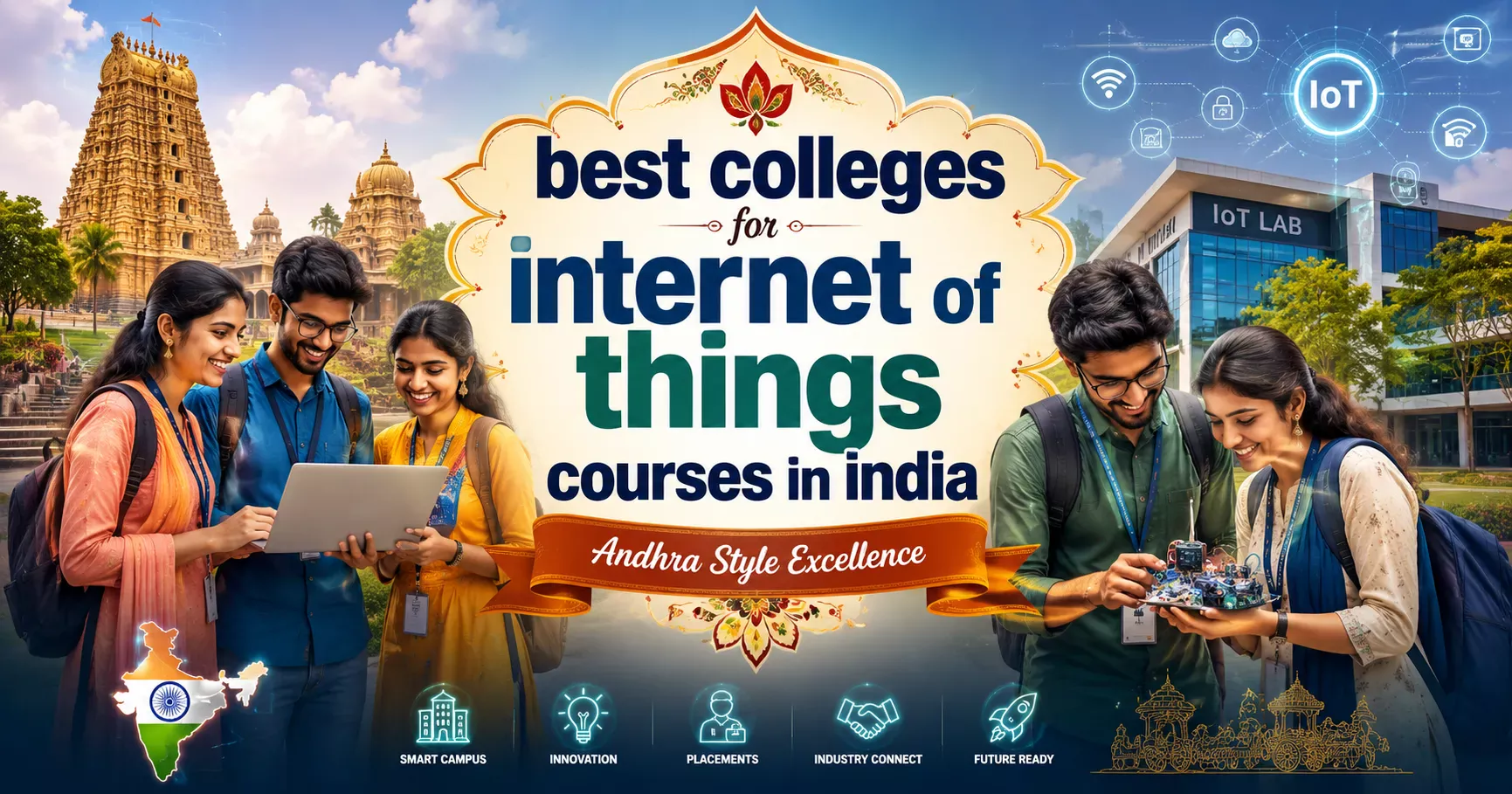
The Internet of Things (IoT) is transforming how people live, work, travel, learn, and communicate. From smart homes and wearable devices to industrial automation and smart cities, IoT has become one of the fastest-growing technology sectors in India and across the world.
As industries increasingly depend on connected devices, the demand for skilled IoT professionals continues to rise. Consequently, many students are actively searching for the best colleges for internet of things courses in india to build successful careers in this emerging field.
Many parents feel anxious about choosing a future-proof engineering specialization. Technology changes rapidly, and selecting the right course can significantly impact a student’s career path. At the same time, students often wonder whether IoT has strong placement opportunities, industry relevance, and long-term growth.
From our years of guiding students at CollegeZollege, we have observed a growing interest in interdisciplinary programs that combine electronics, computer science, artificial intelligence, cloud computing, cybersecurity, and data analytics. IoT perfectly combines all these domains into a single career-focused discipline.
India’s leading engineering institutions now offer specialized IoT programs under:
- B.Tech Internet of Things
- B.Tech IoT and Cyber Security
- B.Tech CSE (IoT)
- B.Tech Artificial Intelligence and IoT
- B.Tech Smart Manufacturing and IoT
- M.Tech Internet of Things
- IoT Certification Programs
According to industry trends, IoT professionals are increasingly being hired by technology companies, manufacturing organizations, automotive firms, healthcare providers, and smart infrastructure projects.
Students who pursue IoT education today can explore careers such as:
| Career Role | Average Starting Salary |
|---|---|
| IoT Developer | ₹4–8 LPA |
| Embedded Systems Engineer | ₹4–7 LPA |
| IoT Solution Architect | ₹8–20 LPA |
| Cloud Engineer | ₹5–12 LPA |
| AI & IoT Specialist | ₹6–15 LPA |
| Smart City Consultant | ₹7–18 LPA |
| Cybersecurity Analyst | ₹5–14 LPA |
Choosing among the best colleges for internet of things courses in india requires careful evaluation of faculty quality, laboratories, industry partnerships, curriculum design, placement records, accreditation, and campus ecosystem.
Before making any admission decision, students can also explore broader college comparisons through https://collegezollege.com/top-colleges-in-bangalore/ which provides insights into leading institutions and emerging technology programs.
Why choose this college/university?
Selecting the right college for IoT education is about much more than rankings.
Students need an institution that offers:
Industry-Oriented Curriculum
The best colleges continuously update their curriculum according to industry requirements.
Modern IoT programs include:
- Sensor Networks
- Embedded Systems
- Cloud Computing
- Artificial Intelligence
- Machine Learning
- Edge Computing
- Robotics
- Data Analytics
- Cybersecurity
Advanced Laboratories
Practical learning plays a critical role in IoT education.
Top institutions provide:
- IoT Innovation Labs
- Robotics Centers
- Smart Device Testing Labs
- Cloud Computing Infrastructure
- AI Research Centers
Strong Industry Collaborations
Many leading colleges collaborate with:
- Microsoft
- Cisco
- IBM
- Intel
- Bosch
- Siemens
- Amazon Web Services
These partnerships provide students with certifications, internships, and live projects.
Excellent Placement Opportunities
Placement remains one of the strongest reasons students choose reputed institutions.
Based on real student feedback, colleges with dedicated technology incubation centers often achieve better placement outcomes because students gain practical exposure before graduation.
Research Opportunities
Students interested in innovation benefit from institutions that support:
- Patent Filing
- Product Development
- Startup Incubation
- Research Publications
Accreditation and Recognition
While selecting among the best colleges for internet of things courses in india, students should verify accreditation status through official bodies such as:
These organizations help ensure educational quality and institutional credibility.
Top Colleges Offering Internet of Things Courses in India
| College | Location | Course Type | Average Placement |
|---|---|---|---|
| IIT Delhi | Delhi | B.Tech/M.Tech IoT Related | ₹18–25 LPA |
| IIT Madras | Chennai | IoT & Smart Systems | ₹20–30 LPA |
| IIT Bombay | Mumbai | IoT Research Programs | ₹18–28 LPA |
| VIT Vellore | Tamil Nadu | B.Tech CSE IoT | ₹7–12 LPA |
| SRM Institute | Chennai | B.Tech IoT | ₹5–10 LPA |
| Amity University | Noida | B.Tech IoT | ₹4–8 LPA |
| Chandigarh University | Punjab | B.Tech IoT | ₹5–9 LPA |
| UPES Dehradun | Uttarakhand | IoT Engineering | ₹5–10 LPA |
| Jain University | Bangalore | IoT Programs | ₹5–9 LPA |
| PES University | Bangalore | IoT Specializations | ₹6–12 LPA |


Courses offered
The best colleges for internet of things courses in india offer multiple undergraduate and postgraduate pathways.
B.Tech Internet of Things
Duration: 4 Years
Subjects Include:
- Programming Fundamentals
- Data Structures
- Embedded Systems
- Sensor Technologies
- Wireless Communication
- Cloud Platforms
- AI Integration
- Cybersecurity
B.Tech CSE with IoT
This is among the most popular choices because it combines computer science fundamentals with IoT specialization.
Key Topics:
- Software Engineering
- IoT Architecture
- Machine Learning
- Cloud Deployment
- Smart Applications
B.Tech AI and IoT
This interdisciplinary program is gaining tremendous popularity.
Students learn:
- Artificial Intelligence
- Deep Learning
- Smart Automation
- Edge Intelligence
- Smart Devices
M.Tech Internet of Things
Suitable for:
- Research Aspirants
- Working Professionals
- Technology Specialists
Certification Programs
Popular Certifications Include:
- AWS IoT
- Cisco IoT
- Microsoft Azure IoT
- IBM Watson IoT
Students interested in comparing technology-focused institutions may also explore https://collegezollege.com/top-private-colleges-in-bangalore/ to understand how private universities are strengthening emerging technology education.
Curriculum Comparison Table
| Subject Area | Weightage |
|---|---|
| Programming | 20% |
| Networking | 15% |
| Electronics | 15% |
| Cloud Computing | 15% |
| AI & ML | 15% |
| Security | 10% |
| Projects | 10% |
Future Scope of IoT in India
India is rapidly adopting smart technologies across industries.
Major sectors include:
Healthcare
Applications include:
- Remote Monitoring
- Wearable Devices
- Smart Hospitals
Manufacturing
Industry 4.0 relies heavily on:
- Sensors
- Predictive Maintenance
- Automated Monitoring
Agriculture
Farmers increasingly use:
- Smart Irrigation
- Soil Sensors
- Weather Monitoring Systems
Transportation
IoT supports:
- Smart Traffic Systems
- Fleet Tracking
- Connected Vehicles
Smart Cities
Government projects increasingly require IoT professionals for:
- Surveillance Systems
- Energy Management
- Smart Utilities
As a trusted education platform, CollegeZollege.com consistently observes rising employer demand for graduates possessing IoT and automation skills.
Fee Structure


Understanding the fee structure is one of the most important steps when selecting from the best colleges for internet of things courses in india.
Many parents feel anxious about balancing educational quality with affordability. Fortunately, India offers a wide range of IoT programs across government institutions, private universities, and deemed-to-be universities.
The total cost varies depending on:
- Institution reputation
- Infrastructure quality
- Location
- Industry partnerships
- Hostel facilities
- International collaborations
Average Fee Structure in India
| Institution Type | Annual Fee Range |
|---|---|
| IITs | ₹2–3 Lakhs |
| NITs | ₹1.5–2 Lakhs |
| Government Engineering Colleges | ₹50,000–1 Lakh |
| Private Universities | ₹1.5–4 Lakhs |
| Premium Private Institutions | ₹3–6 Lakhs |
Estimated Total Program Cost
| College Type | Total 4-Year Cost |
|---|---|
| Government Colleges | ₹2–5 Lakhs |
| NITs | ₹6–9 Lakhs |
| IITs | ₹8–12 Lakhs |
| Private Universities | ₹8–20 Lakhs |
Additional Expenses
Students should also consider:
- Hostel fees
- Examination fees
- Lab charges
- Certification costs
- Project expenses
- Laptop requirements
Many leading colleges provide scholarships based on:
- Merit
- Entrance examination performance
- Sports achievements
- Reserved category benefits
- Financial background
Therefore, students should always check scholarship opportunities before finalizing admission.
Admission process
Admission procedures differ across institutions. However, most colleges follow a structured admission process.
Step 1: Choose Your Preferred Specialization
Popular choices include:
- B.Tech Internet of Things
- B.Tech CSE (IoT)
- AI & IoT
- IoT and Cyber Security
- Smart Systems Engineering
Step 2: Appear for Entrance Exams
Common entrance examinations include:
| Exam | Accepted By |
|---|---|
| JEE Main | NITs, IIITs |
| JEE Advanced | IITs |
| VITEEE | VIT |
| SRMJEEE | SRM |
| CUET | Several Universities |
| COMEDK | Karnataka Colleges |
| KCET | Karnataka Engineering Colleges |
Step 3: Counseling Process
After entrance exam results:
- Register for counseling
- Fill college preferences
- Lock choices
- Participate in seat allocation
Step 4: Document Verification
Required documents generally include:
- 10th Marksheet
- 12th Marksheet
- Entrance Scorecard
- Transfer Certificate
- Migration Certificate
- Passport Photos
- Identity Proof
Step 5: Fee Payment
After seat allotment:
- Pay admission fee
- Confirm enrollment
- Complete registration
Students interested in technology-focused institutions can review additional admission insights through https://collegezollege.com/how-to-choose-the-right-college-in-bangalore/ which explains important college selection factors.
Eligibility criteria
Eligibility requirements remain fairly consistent across most institutions offering IoT programs.
Undergraduate Eligibility
Academic Qualification
Candidates must complete:
- Class 12
- Physics
- Chemistry
- Mathematics
Minimum Marks
| Institution Type | Minimum Marks |
|---|---|
| IITs | Through JEE Rank |
| NITs | Through JEE Main |
| Private Universities | 50–60% |
| Government Colleges | 45–60% |
Age Criteria
Most colleges do not impose strict age restrictions.
Postgraduate Eligibility
For M.Tech IoT:
Students generally require:
- B.Tech
- BE
- Relevant Engineering Degree
Preferred backgrounds include:
- Computer Science
- Electronics
- Information Technology
- Electrical Engineering
Essential Skills for IoT Students
Successful IoT professionals often possess:
Technical Skills
- Coding
- Networking
- Data Analytics
- Cloud Computing
Soft Skills
- Communication
- Problem Solving
- Creativity
- Team Collaboration
Students often wonder whether strong coding knowledge is mandatory.
The reality is that coding becomes easier through practice, and quality colleges provide extensive support through labs, workshops, and mentoring programs.
Placement & career outcomes


Placement opportunities are among the strongest reasons students pursue IoT education.
According to industry data, IoT professionals are increasingly recruited across:
- IT Services
- Manufacturing
- Healthcare
- Automotive
- Telecommunications
- Smart Infrastructure
Top Recruiters
| Company | Hiring Areas |
|---|---|
| Microsoft | Cloud IoT |
| Amazon | AWS IoT |
| IBM | Smart Systems |
| Bosch | Industrial IoT |
| Cisco | Networking |
| Intel | Embedded Systems |
| Siemens | Automation |
| TCS | Digital Transformation |
| Infosys | IoT Development |
| Wipro | Smart Solutions |
Salary Expectations
Entry-Level
| Role | Salary |
|---|---|
| IoT Developer | ₹4–8 LPA |
| Embedded Engineer | ₹4–7 LPA |
| Network Engineer | ₹3.5–7 LPA |
| Cloud Associate | ₹5–9 LPA |
Mid-Level
| Role | Salary |
|---|---|
| IoT Architect | ₹12–25 LPA |
| Solution Consultant | ₹10–22 LPA |
| Automation Specialist | ₹10–20 LPA |
Senior-Level
| Position | Salary |
|---|---|
| Chief Technology Officer | ₹30–80 LPA+ |
| IoT Director | ₹25–60 LPA |
| Technology Consultant | ₹20–50 LPA |
Based on real student feedback, institutions emphasizing practical projects and internships often achieve stronger placement outcomes.
Furthermore, students can explore highly rated institutions through https://collegezollege.com/naac-a-colleges/ when comparing academic quality and accreditation standards.
Campus & facilities
A strong IoT program requires far more than classroom learning.
The best institutions invest heavily in infrastructure.
Essential Facilities
IoT Innovation Labs
Students work with:
- Sensors
- Microcontrollers
- Raspberry Pi
- Arduino Boards
Robotics Centers
Hands-on exposure helps students understand automation systems.
Smart Classrooms
Features include:
- Interactive Displays
- Digital Simulations
- Virtual Labs
Research Centers
Students can participate in:
- Research Projects
- Publications
- Innovation Competitions
Incubation Centers
Many students aspire to launch startups.
Incubation facilities provide:
- Funding Support
- Mentorship
- Industry Networking
Hostel Facilities
Quality hostels generally offer:
- Wi-Fi Connectivity
- Study Rooms
- Security Systems
- Recreation Areas
Many parents prioritize campus safety when evaluating colleges. Reputed institutions invest significantly in student security and support services.
Library Resources
Modern libraries provide:
- E-books
- Research Journals
- IEEE Access
- Digital Learning Platforms
These resources become extremely valuable during project development and research activities.
Student life & culture


Student life extends far beyond academics.
The best colleges for internet of things courses in india create an environment where students grow personally and professionally.
Technical Clubs
Popular student organizations include:
- Robotics Club
- Coding Club
- IoT Society
- Innovation Cell
- Entrepreneurship Cell
Hackathons
Students regularly participate in:
- National Competitions
- Smart India Hackathon
- Startup Challenges
- Product Development Events
Cultural Activities
Balanced student life includes:
- Music Festivals
- Dance Competitions
- Sports Meets
- Literary Events
Industry Exposure
Students benefit from:
- Industrial Visits
- Guest Lectures
- Corporate Workshops
- Internship Programs
From our years of guiding students at CollegeZollege, we have observed that active campus involvement significantly improves confidence, communication skills, and employability.
Students considering Karnataka institutions may also benefit from reviewing https://collegezollege.com/bangalore-colleges-guide-/ for broader academic opportunities.
Alternative options
While IoT is an excellent specialization, some students may wish to compare related fields.
Popular Alternatives
| Course | Focus Area |
|---|---|
| Computer Science Engineering | Software Development |
| Artificial Intelligence | Intelligent Systems |
| Data Science | Analytics |
| Cyber Security | Digital Protection |
| Robotics Engineering | Automation |
| Electronics & Communication | Hardware Systems |
| Information Technology | IT Infrastructure |
AI and IoT
This combination is becoming particularly popular because connected devices increasingly depend on artificial intelligence.
Cyber Security and IoT
As connected systems grow, security becomes increasingly important.
Robotics and IoT
Robotics applications often integrate IoT technologies for real-time communication and control.
Students exploring broader university ecosystems may also review https://collegezollege.com/bangalore-university-colleges/ to compare multiple engineering disciplines.
FAQs
1. Is IoT a good career option in India?
Yes. IoT is among the fastest-growing technology domains with strong opportunities across industries.
2. Which is the best specialization within IoT?
AI and IoT, Cyber Security and IoT, and Smart Systems are currently among the most popular specializations.
3. Can IoT students get software jobs?
Yes. Many graduates secure software development, cloud computing, and technology consulting roles.
4. Is coding mandatory for IoT?
Programming knowledge is essential, but colleges teach coding from foundational levels.
5. What is the average salary after IoT engineering?
Fresh graduates commonly earn between ₹4–8 LPA depending on skills and institution.
6. Which entrance exams are required?
JEE Main, JEE Advanced, VITEEE, SRMJEEE, COMEDK, and CUET are common pathways.
7. Are internships important?
Yes. Internships provide practical experience and often improve placement opportunities.
8. Does IoT have opportunities abroad?
Absolutely. Global demand for IoT professionals continues to expand.
9. Is IoT better than traditional computer science?
Both fields have strong prospects. IoT provides additional exposure to hardware, networking, and automation.
10. Which cities offer the best IoT opportunities?
Bangalore, Hyderabad, Chennai, Pune, Delhi NCR, and Mumbai are major technology hubs.
11. Can IoT graduates start their own companies?
Yes. Many IoT graduates develop products and launch startups through incubation centers.
12. Is mathematics important for IoT?
A strong understanding of mathematics helps with programming, analytics, and engineering concepts.
13. Are government colleges good for IoT?
Yes. IITs, NITs, and leading state universities provide excellent education and research opportunities.
14. What industries hire IoT graduates?
Healthcare, manufacturing, automotive, telecommunications, agriculture, logistics, and smart city projects.
15. How should students choose among the best colleges for internet of things courses in india?
Students should evaluate curriculum, placements, faculty, infrastructure, industry collaborations, accreditation, and overall learning environment.
Final Thoughts / Key Takeaway / Final Perspective
The future of connected technology is already here. Smart homes, autonomous vehicles, industrial automation, healthcare monitoring systems, and intelligent cities are transforming everyday life. As a result, demand for skilled IoT professionals is expected to grow steadily throughout the coming decade.
Choosing among the best colleges for internet of things courses in india requires thoughtful research and careful planning. Students should focus not only on rankings but also on curriculum quality, practical learning opportunities, faculty expertise, industry partnerships, placement outcomes, and overall campus culture.
We have helped hundreds of students choose the right college, and one lesson remains consistent: the best college is the one that aligns with your career goals, learning style, financial situation, and long-term aspirations.
As a trusted education platform, CollegeZollege.com always guides parents with transparent information so students can make confident decisions about their future.
Seats for best colleges for internet of things courses in india are filling rapidly, and if you want priority support, simply submit the form below — our expert team will help you secure admission with zero hidden charges.